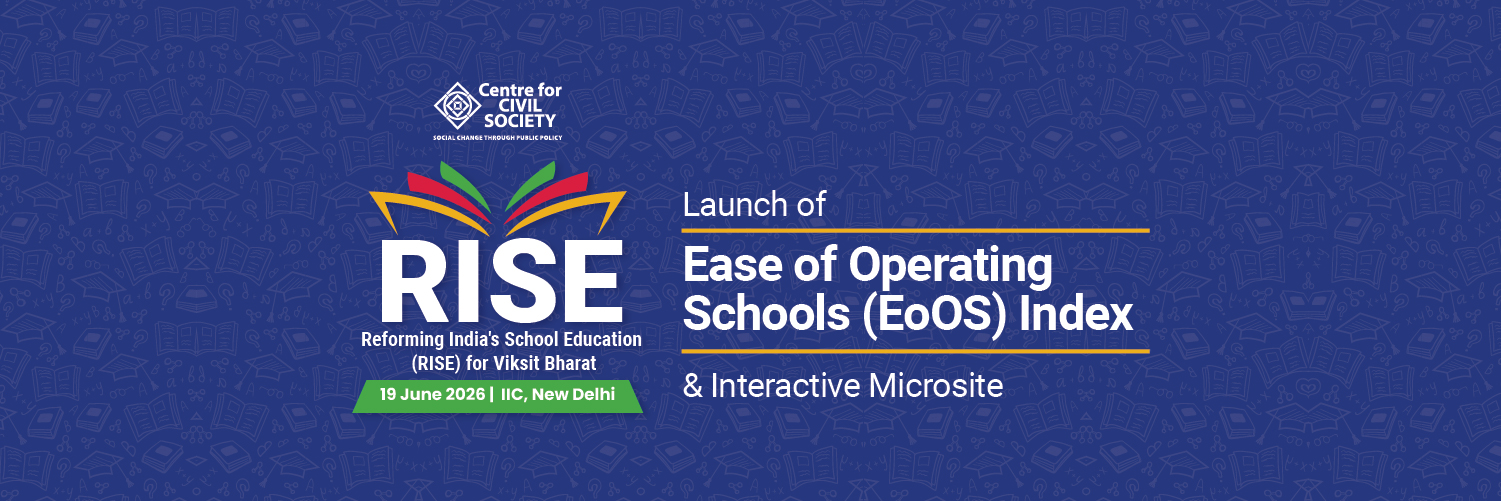
As India embarks on her journey towards Viksit Bharat, platforms to discuss and debate opportunities, challenges and solutions are crucial.
Reforming India's School Education (RISE) for Viksit Bharat is Centre for Civil Society’s contribution towards convening such spaces to explore the path forward in education.
The event is envisioned to be a platform bringing together diverse stakeholders and experts in school education to uncover gaps and challenges that must be addressed to ensure India’s vision of Viksit Bharat is realised.
The 2 key elements of RISE for Viksit Bharat:
- Ease of Operating Schools (EoOS) Index & Website launch by Group Captain Shubhanshu Shukla, Test Pilot IAF & ISRO Astronaut
- Interactive panel discussion on 'Reforming India's School Education':
Panel moderator: Gurcharan Das, Author & Public Intellectual
Panel Speakers:
- Indrani Bhaduri, CEO & Head, PARAKH
- Shailendra Sharma, Former Principal Advisor to Director of Education Government of Delhi
- Dr. Taneya Singh, School Education Consultant, NITI Aayog
- Vardan Kabra, Co-founder, Fountainhead Schools & Senior VP ARISE Governing Body
- Sunita Johar: Additional Director (Academics), Army Welfare Education Society
Event Summary
The Welcome Address delivered by Dr. Amit Chandra, CEO Centre for Civil Society highlighted room for reforms in school operation and emphasized on the need of states to try something new. Additionally, he identified that the window of opportunity for India’s population to be a high-capacity generation is closing, and we need to act fast and think of out-of-the-box solutions to tap into this potential. He reminded us that the human capital entering India’s workforce in 2047 is sitting in Grade 1 today and thus, we must figure out a roadmap to pick up momentum to democratise education.
EoOS Index & findings were presented to the gathering by Dr. Animesh Kumar, Author of EoOS. Shedding light on the state of student enrolments, he pointed out that 50% of all students in the country are enrolled in non-state actor run schools. This is the Governance Paradox where despite high student enrolments, private schools are financially and operationally constrained to follow multiple, and overlapping compliance procedures.
Focusing on the state rankings from the report, Dr. Kumar emphasized that while top performing states like Telangana, Andhra Pradesh, Haryana have substantially less complex procedural requirements, the index is intended as a learning tool which states can use to identify & learn from peers that perform well on EoOS indicators.
The Keynote address delivered by Group Captain Shubhanshu Shukla focused on developing an adaptive workforce prepared to deal with the unknowns, and thus the need to cultivate a culture of innovation & curiosity.
The EoOS interactive website was launched by Group Captain Shubhanshu Shukla along with Gurcharan Das, Dr. Amit Chandra and the authors of the EoOS Index. They were joined by the Panel Speakers for unveiling the EoOS Index Report.
An engaging panel discussion on “Reforming India’s School Education” was moderated by Gurcharan Das. The interactive discussion explored private & public sector perspectives of school education & governance.
Gurcharan Das highlighted the need to reform India’s education, to make education real and relevant. Bringing experience from the public sector, Prof. Indrani Bhaduri explained the government's efforts to track education outcomes through initiatives like Holistic Progress Cards and convert curriculum from a rote-learning approach to enquiry-based learning.
Shailendra Sharma identified 3 areas which require reforms: teaching & learning, examination and overall framework of school management since the current school regulations are based on infrastructure and not learning outcomes. Dr. Taneya Singh shed light on the compliance burdens faced by government schools. The most important aspect, as emphasized by Dr. Singh, is to regulate the instructional time that teachers are giving in the classrooms to improve the quality of teaching, regardless of the type of school- government or private. Sunita Johar explained the army school model where there is focus on project-based learning with ideathons, skill expos with creative thinking and problem solving. Commenting on education as a high investment touchpoint, Vardan Kabra expressed that weak state capacity will not solve the education problems of today and that an increased autonomy, as observed in the best education systems like Scandinavian and Finnish models.
The afternoon concluded with an interactive Q&A where panelists responded to questions posed by audience members. Diverse questions were raised including commercialisation of education for the development of schools and teachers, how standardisation of education would work with autonomy when discrimination based on the different standards for private and public schools exists and more.


