About the School Choice National Conference
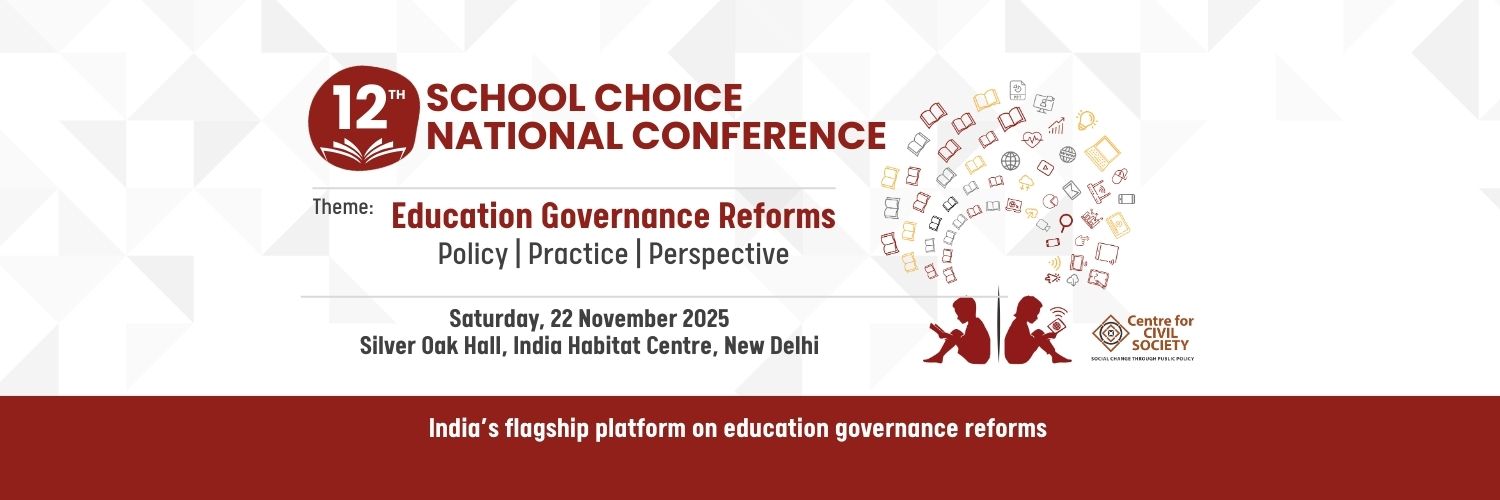
School Choice National Conference (SCNC), started in 2009, is the flagship education conference hosted by the Centre for Civil Society (CCS) in New Delhi every year. The day-long conference aims to bring together educationists, planners, policy experts, activists, and government officials to explore, discuss and debate various dimensions of school education in India...
Since 2009, SCNC has been the only national forum in India dedicated to system-level education reforms...
After five years, SCNC returns in person...
This year’s theme: Education Governance Reforms – Policy | Practice | Perspective
Focus 2025: Four Bold Reform Ideas
The 12th SCNC will spotlight the theme of Education Governance Reforms, a return to first principles in designing accountability, financing, and regulatory structures for India’s schools. Each of the following three reform ideas will be examined not only in theory but also in practice, with perspectives drawn from policy, implementation, and comparative global experience:
- Enquiry-Based Learning Moving beyond rote memorisation to enquiry-driven pedagogy that strengthens critical thinking and problem-solving.
- New Age Governance Framework Breaking conflicts of interest by separating the state’s roles as provider, policymaker, and regulator, and ensuring transparent, proportionate oversight. Also, re-examining restrictions on school provision to responsibly unlock private investment and innovation, while ensuring equity and quality safeguards.
- Direct Benefit Transfers in Education “Fund Students, Not School” Reorienting public finance from input-based subsidies to direct, portable entitlements for families, ensuring resources follow the child.
Conference Features
- Keynote Sessions with reform leaders and leading policymakers
- Panel Discussions on the four reform ideas, bringing together policymakers, practitioners and researchers on the same forum
- Participant Engagement to crowdsource perspectives from practitioners and policymakers
- Exhibition Zone for innovative education solutions
- Networking Spaces for collaborations across government, philanthropy, and civil society
Why Attend SCNC 2025?
- Engage with leading voices...
- Participate in evidence-based...
- Connect with a cross-sector ecosystem...
- Contribute to shaping...
Registration
General Delegates / NGOs / Corporates: Fee: Rs. 2,500
Students: Fee: Rs. 2,000
Contact
S. R. Thomas Antony – +91 84478 67144
Email: scnc@ccs.in
The Legacy of SCNC
Since its inception, SCNC has been a launchpad for bold reform ideas that have shaped national and state-level conversations on education policy. The earliest editions opened the debate on school vouchers in India, drawing from experiments and building the intellectual case for financing reforms that fund students rather than schools. In later years, the conference hosted rigorous critiques of the Right to Education Act, highlighting the unintended consequences of compliance-heavy regulation on both private and government schools.
Discussions on public–private partnerships at SCNC informed pilots in multiple states, while the first sustained advocacy for independent school regulation, what we now know as the State School Standards Authority, was seeded in SCNC dialogues on Separation of Powers. The conference has also been the meeting ground for reform champions, where bureaucrats, economists, school leaders, and civil society actors debated the mechanics of choice, competition, and accountability. For many participants, these conversations were not only intellectually formative but also the starting point for collaborations that continue to shape reform initiatives today.
The return of SCNC after five years is therefore not simply a revival of a conference. It is the reactivation of an institutional memory and reformist tradition, one that has consistently kept the spotlight on systemic transformation when the policy discourse was often preoccupied with incremental or input-driven interventions.
Schedule
| Time | Particulars | Speakers |
|---|---|---|
| 9:00 AM | Registration and Expo Opens | - |
| 9:15 AM | Tea Break | - |
| 10:00 AM | Welcome Address | Nitesh Anand |
| 10:05 AM | Keynote Address | Mr Baijyant "Jay" Panda |
| 10:35 AM | Special Address | Video message by Mr Gurcharan Das |
| 10:40 AM | Spotlight Dialogue #1 Reimagining Education: Choice, Equity, and the Future of Learning |
Ms Asmita Satyarthi Dr Amit Chandra |
| 11:00 AM | Spotlight Dialogue #2: Enquiry Based Learning |
Mr Sanyam Bharadwaj Dr Amit Chandra |
| 11:15 AM | Panel 1: Enquiry Based Learning |
Aditi Mehta, Excel-One- Moderator Pankaj Das, Assam Manju Gupta, Adhyayan Joyce Poan, UNESCO Sanyam Bharadwaj |
| 12:30 PM | Lunch Break | - |
| 1:15 PM | Skits / Nataks / Performance / Interactive Session | Students of Hari Vidya Bhawan |
| 1:30 PM | Spotlight #3: New Age Governance Framework |
Ms Vedita Reddy, IAS Director – School Education, Government of Delhi |
| 1:45 PM | Session 2: New Age Governance Framework (SSSA, Deregulation frameworks, Breaking the not-for-profit barrier) |
Kapil Khurana, CSF (Moderator) Pranati Panda NP Singh Vinesh Menon Shailendra Sharma |
| 3:00 PM | Tea Break | - |
| 3:15 PM | Spotlight #4: DBT in Education |
Dr J P Narayan Dr Parth J Shah |
| 3:45 PM | Session 3: Direct Benefit Transfer (DBT) – "Fund Students Not Schools" |
Dr Amit Chandra (Moderator) Sujatha Muthayya, New Globe Rahul K Sharma, Indus Action Kulbhushan Sharma, NISA |
| 4:45 PM | Conclusion & Vote of Thanks | Nitesh Anand |
| 5:00 PM | Official Closing | - |
Meet the Speakers

Dr. Parth J Shah
Parth J. Shah is the Founder President of the Centre for Civil Society (CCS) and the Founder of the National Independent Schools Alliance (NISA), a federation of 80,000 budget private schools in India. Dr Shah’s research and advocacy work focuses on the themes of economic freedom, choice and competition in education, property rights approach for the environment, and good governance.
He has edited and published extensively in international and Indian journals and the popular press on issues ranging from currency regulation to education policy. He holds a PhD in Economics from Auburn University and has taught at the University of Michigan. He has been a visiting faculty at Jawaharlal Nehru University and M.S. University, and has served on the Senate of the Central University of Himachal Pradesh and Tamil Nadu. He has also been a member of several state and union government task forces, including the education task forces of the Governments of Delhi and Karnataka.
He recently joined the Board of Directors of the Atlas Network, USA.
Dr. Kulbhushan Sharma
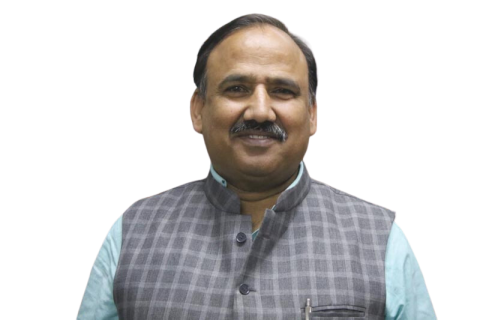
Kulbhushan is the President of Federation of Private Schools Association, Haryana. He is also President of the National Independent Schools Alliance (NISA), State President of Patriotic Forum of India and State Working President of National Human Rights Protection Organisation. Previously, he has been a general council member of the Rashtriya Madhyamik Shiksha Abhiyan and a member of the School Education Rules Review Committee.
Prof. Pranati Panda
Prof. Pranati Panda is a distinguished academician with over four decades of experience in educational planning, policy formulation, and institutional development. She served as Senior Professor and Dean of Academics and Research at the National Institute of Educational Planning and Administration (NIEPA), New Delhi. She held key academic positions at premier institutions, including the National Council of Educational Research and Training (NCERT) and the National Institute of Public Cooperation and Child Development (NIPCCD).
At NIEPA, she led several strategic departments, including the Department of School and Non-Formal Education, the School Standards and Evaluation Unit, and the Department of Comparative Education and International Cooperation. Prof. Panda currently chairs the Bureau of Indian Standards (Education Services Sector) and serves on the Executive Board of the Council of Boards of School Education (COBSE). She has also contributed to multiple expert committees under the Ministry of Education, the National Council for Teacher Education (NCTE), and various Central and State universities, and played a pivotal role in the Joint Review Missions for Centrally Sponsored Schemes on school and teacher education, shaping national strategies for educational transformation. The academic journey of Prof. Panda, over four decades, has witnessed many milestones.

Kapil Khurana
Kapil Khurana started his career as a teacher and content writer, and has 20 years of experience in K-12 school learning improvement specialising in large-scale assessments, educational measurements and policy shaping. He founded an EdTech enterprise focused on classroom process improvement that impacted over 8,000 teachers and 200,000 learners across early childhood and elementary school levels in India and the Middle East. Now, Kapil leads School Governance in Central Square Foundation, and is working with four Indian state governments in supporting their governance reforms on enhancing transparency and accountability that promote better learning outcomes in all schools, government and private.

Pankaj Das
Pankaj Das has dedicated nearly his entire professional career to education, serving as a teacher, Vice Principal, Principal, and currently as Director, Modern English School, Kahilipara, Guwahati. He also serves as the Advisor to the All Assam Private Schools Association.
Before joining Modern English School, he co-founded an NGO and worked in a village near Guwahati, contributing to community development and education initiatives. He is also the founder of Anibadh – Truth and Liberty, a YouTube channel and podcast available on Spotify.

Prof. Indrani Bhaduri
Prof Indrani Bhaduri is CEO and Head of PARAKH and the Educational Survey Division at the National Council of Educational Research and Training (NCERT), Ministry of Education, Government of India.
With over 27 years of experience in educational assessment and allied disciplines, her expertise spans psychometrics, test design, large-scale achievement surveys, and school-based assessments aimed at improving learning outcomes. At NCERT, she has led several national-level initiatives focused on planning, implementation, and dissemination of learning achievement studies across India.
She is also deeply involved in policy-level collaborations with state governments and educational agencies under the Samagra Shiksha framework. A key highlight of her work is the development of Holistic Progress Cards, which redefined traditional assessment practices to align with the holistic and inclusive needs of learners.
Additionally, Prof. Bhaduri has played a pivotal role in establishing equivalence frameworks across school boards, ensuring fairness and consistency in student evaluation and enabling smoother academic transitions across diverse educational systems.
Dr. Jayaprakash Narayan
Dr. Jayaprakash Narayan is a noted education researcher and policy analyst.
Jayaprakash Narayan is an Indian liberal politician, activist and a former public administrator. He is the founder and president of Lok Satta Party. He served as a Member of the Legislative Assembly from Kukatpally constituency of Andhra Pradesh in India. He is a physician by training. He is also the founder and General Secretary of Foundation for Democratic Reforms, an independent public-policy think-tank and research-resource center. Jayaprakash is also a political reformer and columnist. He is well known for his role in electoral reforms and the Right to Information act.

Shailendra Sharma
Advisor, Indus Action
Shailendra Sharma is an independent education consultant advising organisations and thought leaders in India and abroad. He previously served as Principal Advisor to the Director of Education, Government of NCT of Delhi (2016–2024), where he worked closely with the Education Ministers and the Directorate of Education to design and implement key reforms in the public school system. His work focused on teacher and school leadership development, the introduction of innovative curricula, the establishment of specialised excellence schools, the creation of a new school education board, and the strengthening of parent–school partnerships.
Shailendra began his career with Pratham, one of India’s largest non-profit organisations, where he led large-scale initiatives for nearly two decades to improve access to and learning outcomes for children nationwide. He is a Salzburg Global Fellow, co-author of the Salzburg Statement on Social Emotional Learning, and a member of the Education Policy Network at the Salzburg Global Seminar.

Dr Rahul Karnamadakala Sharma
Director, Impact & Research at Indus Action
Dr Rahul K Sharma is the Director of Impact and Research at Indus Action, a leading policy Implementation organisation working to enhance access to welfare entitlements for the Indian people. He is also a Research Fellow at University College London (UCL), where he works in the School of Public Policy on questions of State Capacity, specifically Relational State Capacity.
Rahul’s research and practice focus on social protection and welfare, state capacity, state- citizen relations, and monitoring and evaluation. He has published widely on these topics, including in the journals Science, Nature Energy, and Energy for Sustainable Development. He was an Associate Editor for the Journal of Environment and Development and Lead Author of UNEP’s Global Environmental Outlook on Cities 2021. He was also a National Data Innovation Centre (NDIC) Fellow at the National Council for Applied Economics Research (NCAER), New Delhi.
After initial training in Electrical and Renewable Energy Engineering, Rahul was a Postgraduate Fellow at Yale University, and received an MPP from the Humphrey School of Public Affairs, University of Minnesota, Twin Cities, and a PhD in Public Management and Quantitative Methods from the Bren School of Environmental Science and Management, University of California, Santa Barbara, as a Regents’ Scholar.

Dr. Sanyam Bhardwaj
Controller of Examination, CBSE
Dr. Sanyam Bhardwaj is serving as the Controller of Examinations at CBSE since 2018, overseeing the conduct and result declaration of Class X and XII Board exams for over 46 lakh students annually across India and 26 countries. His tenure is marked by key reforms ensuring fairness, transparency, and efficiency in school and medical entrance examinations.
He played a pivotal role in conducting AIPMT/NEET-UG for 13 years and conceptualized the NEET scheme. Prior to CBSE, he contributed significantly at NIOS, NCTE, RIMC Dehradun, and Meerut College. Dr. Bhardwaj holds multiple advanced degrees including M.Sc. (Physics & Electronics), M.Ed., MBA (EM), and Ph.D. in Education, and is an alumnus of IIM Ahmedabad. He has published internationally and received several honors including the Digital India Award and Police Commendation Certificate.
Key Achievements: COVID-19 result policy approved by the Supreme Court NEP-2020 aligned dual exam scheme for Class X Harmonized syllabi in core science subjects Inclusive education initiatives for CWSN students ICT integration and examination integrity reforms International recognition for CBSE students in foreign universities
Dr. Bhardwaj’s work continues to shape India’s education landscape with innovation, equity, and global relevance.
Dr. NP Singh
Ex Secretary, Min.of Urban Devt, GOI & Chairman DMRC Ltd. | Vice Chairman, Retd. IAS Officers' Forum, Uttarakhand
एन.पी. सिंह, सेवानिवृत्त आई.ए.एस. अधिकारी द्वारा अनेक महत्वपूर्ण पदों पर तैनाती के दौरान जनकल्याण की योजनाओं एवं विकास कार्यक्रमों का सफल संपादन किया गया। एक बहुत ही उल्लेखनीय कार्य चर्चा में रहा है जब वर्ष 2000 में नैनीताल में पोस्टिंग के दौरान नैनी झील की सफाई जन सहयोग से बिना किसी शासन की धनराशि खर्च किए हुए कार्य किया गया। सेवा के अतिरिक्त सामाजिक सरोकारों से संबंधित भी अनेक कार्य अपने निजी प्रयासों एवं संसाधनों द्वारा किए गए। मुख्यतः आदिवासी समुदायों के उत्थान के लिए विशेष प्रयास किए गए। उदाहरण के लिए मिर्जापुर में कौल समुदाय के युवाओं के व्यावसायिक प्रशिक्षण हेतु आई.टी.आई. की स्थापना करवाई गई। छत्तीसगढ़ के नक्सल प्रभावित क्षेत्रों में भी कई स्थलों पर निःशुल्क काउंसलिंग एवं कोचिंग सेंटर्स चलाए जा रहे हैं, जिससे वहां के युवा मुख्य धारा में सम्मिलित हों। बावरिया समुदाय को अपराध से दूर करने हेतु एक सघन अभियान चलाया गया और वहां के युवकों/युवतियों को शिक्षा एवं रोजगार से जोड़ा गया। वाराणसी के ग्रामीण क्षेत्र में बालिकाओं के नि:शुल्क अध्ययन के लिए एक विद्यालय 12वीं कक्षा तक संचालित किया जा रहा है। वाराणसी के आसपास के सात जिलों के वनवासी (मुसहर) समुदाय के युवाओं को वीर बिरसा मुंडा के नाम से छात्रवृत्ति देकर मेधावी विद्यार्थियों को उच्च शिक्षा की ओर प्रेरित किया जा रहा है। इन कार्यों के लिए श्री सिंह को कई संस्थानों द्वारा अनेकों अवार्ड भी मिल चुके हैं। श्री सिंह हिंदी साहित्य के रचनाकार भी हैं। उनके कई काव्य संग्रह भी प्रकाशित हो चुके हैं और उनकी कविताओं में भी सामाजिक पीड़ा केंद्र में रहती है।
वर्तमान में भारत सरकार द्वारा गठित और पतंजलि योगपीठ द्वारा संचालित भारतीय शिक्षा बोर्ड के कार्यकारी अध्यक्ष हैं और उसके माध्यम से आधुनिक शिक्षा में भारतीय प्राचीन ज्ञान परंपरा को समन्वित करते हुए शिक्षा के भारतीयकरण के लिए समर्पित हैं।
Manju Gupta
Director Programmes , Adhyayan Quality Education Foundation
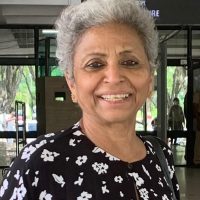
Manju is a highly experienced educator with over five decades in the field, including 30 years as Principal across leading CBSE, Cambridge, and IBO institutions.
She holds an M.Sc. (Physics) and B.Ed., and has been honoured with several prestigious awards, such as the National T eachers Award (1999), Pride of India Award, Inspiring Educators Award, and Acharya Siromani Award. Schools under her leadership have consistently achieved national recognition for quality and performance.
She is Director Programmes , Adhyayan Quality Education Foundation. Also she is an advisor to multiple schools in Delhi and Punjab and also an expert School Quality Assessor.
She trains and facilitates with organisations including Pearson, CBSE, Cambridge International, Image Consultants, and I-Create etc.
Her professional memberships include the National Association of Physics Teachers and the IIM Ahmedabad Alumni Association.
Her expertise spans curriculum and assessment design, leadership development, institutional audits, school improvement strategy, and quality assurance, and she strongly believes in fostering holistic learning and development of all stakeholders in education ecosystem.

Sujatha Muthayya
Vice-President of Policy and Partnerships, NewGlobe
Sujatha has worked on developing service delivery with a particular focus on affordable education over the last two decades. With new globe, she has set up STAR EDUCATION the government of Manipur’s flagship initiative that worked on transforming education in government schools across Manipur through the conflict. she led the institution's entry into India through the establishment of government infrastructure partnership with the government of Andhra Pradesh. She is focused on delivering scale and impact for other governments across the world with NewGlobe .
She began her career with the Centre for Civil Society as a Research Associate. Over the years, she has worked with the Rural Technology and Business Incubator setting up technology enabled last mile delivery for rural markets , Professor James Tooley where she set up a service delivery for 55 low fee private schools across Hyderabad , Intellecap where she set up Sankalp and the south Asian platform for impact investing, the Centre for Civil Society where she headed school choice work, and Pearson where she worked in large scale education partnerships with government.

Asmita Satyarthi
CEO, Satyarthi Movement for Global Compassion (SMGC)
Asmita Satyarthi is the Chief Executive Officer of the Satyarthi Movement for Global Compassion (SMGC). She is committed to driving compassionate action and compassionate leadership across all walks of life to achieve justice, peace, equality, and sustainability globally.
A global leader and social reformer, Ms Satyarthi holds an MBA from the Indian School of Business. She has spearheaded various organisations, including the Global Sustainability Network, Wockhardt Foundation, and Goodera, among others. Her diverse experience spans the US Department of Justice, the International Labour Organisation, and grassroots work in India and other geographies.
Ms Satyarthi has spoken at prominent global platforms such as the Baku Forum, the United Nations General Assembly (UNGA), and several other international and multilateral forums. She has received several prestigious awards, including the US State Department’s Exceptional Leadership for Social Justice award, the Rotary Club of Mumbai’s Young Achievers Award, and the Dainik Bhaskar Group’s Police Pride Award in Rajasthan.
Photography Competition
Photos capturing real moments of learning and teaching — in classrooms, playgrounds, and beyond.
Submission Deadline: 10 November 2025
Result & Prize Distribution: 22 November 2025 at SCNC 2025, Silver Oak Hall, India Habitat Centre, New Delhi
What we’re looking for
- Authentic photos showing the evolving landscape of education in India
- Real moments of learning and teaching in classrooms, playgrounds and communities
Submission Guidelines
- Submit up to 3 original photos (minimum 1, maximum 3). No AI-generated or heavily edited images.
- Format: JPEG or PNG — Minimum 2000px on the longer side.
- Caption required: 50–100 words including where the photo was taken, what it depicts, and why it is significant.
- Permissions: obtain consent from identifiable individuals (especially minors).
Follow @ccsindia on Instagram for prompts and updates.
For queries: scnc@ccs.in | S. R. Thomas Antony: +91 84478 67144