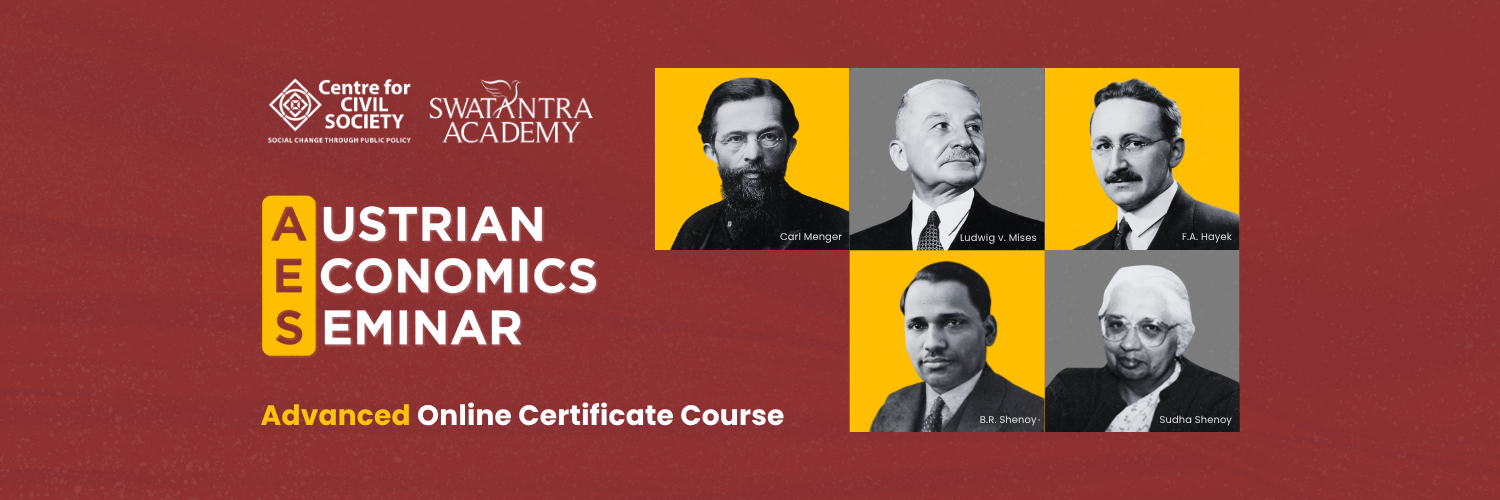
What is the “Austrian School of Economics?”
Rooted in the tradition of Austrian-born economists Carl Menger, Ludwig von Mises, and F.A. Hayek, “Austrian” economics is not a specific field within economics, nor is it a set of conclusions. It is a different approach to understanding social reality that dissents from mainstream method, theory, and policy.
While mainstream neoclassical economics constructs mathematical models and uses statistical methods to estimate variables and parameters, Austrian economists employ theoretical deductive reasoning. The starting point is the “action axiom,” which recognizes that human beings act purposefully, from which logical implications are developed. The Austrian school thus promotes an economic and social thinking that is not confined to the unrealistic assumptions of abstract mathematical models.
Austrians also hold that economic phenomena are not the expression of some hypostatized entity like “society,” but rather the result of individual human action. What makes this school unique, therefore, is its level of analysis: one that focuses on autonomous entrepreneurial initiative and the free interaction of individuals in the marketplace.
About Austrian Economics Seminar:
The Austrian Economics Seminar (AES) is a 3-week advanced online certificate course run by the Centre for Civil Society.
This rigorous online program introduces participants to the fundamental theoretical insights of the Austrian school of economics in an accessible way and demonstrates the relevance of these insights to questions that matter for India: what conditions give rise to prosperity and freedom, and what conditions produce poverty and oppression. AES thus aims to equip participants with tools and principles based on sound economic theories that they can apply in analyzing policies.
The program is delivered through a combination of live lecture-based sessions and interactive Socratic reading groups
Timing:
This seminar runs across three weekends: 25-26 July, 1-2 August, and 8-9 August. Each day will feature at least four hours of instruction, divided into a morning session and an evening session.
Confirmed Sessions and Speakers:
1. Austrian Theory of Money by Lawrence H White (Professor Emeritus of Economics at George Mason University)
2. Socialist Calculation Debate by Peter Boettke (Distinguished University Professor of Economics at George Mason University, the BB&T Professor for Study of Capitalism, and Director, F A Hayek Program at Mercatus Center)
3. Classical Liberalism and Robust Political Economy by Mark Pennington (Professor of Political Economy and Public Policy at King’s College London)
4. Subjectivism in Austrian Economics by Richard Ebeling (Distinguished Professor at The Citadel in Charleston, South Carolina)
5. Market Failures by Parth J Shah (Founder President of Centre for Civil Society and Co-Founder, Dean, and F A Hayek Professor of Spontaneous Order at the Indian School of Public Policy)
6. Theory of Entrepreneurship and How Markets Work by Per Bylund (Johnny D Pope Chair in Entrepreneurship and Associate Professor of Entrepreneurship in Spears School of Business at Oklahoma University)
7. On Don Lavoie and Planning by Andrew Humphries (Assistant Professor of Economics and Great Books at New College of Florida)
8. Defending Austro-libertarianism by Walter Block (Harold E Wirth Eminent Scholar Chair in Economics in the College of Business, at Loyola University New Orleans and Adjunct Scholar at Mises Institute and the Hoover Institute)
9. Indian Central Planning and Liberal Tradition by Kumar Anand (Senior Fellow, CCS)
10. History and Overview of Austrian Economics by Samrudha Surana (PhD student, Economics at George Mason University and Graduate Fellow with F A Hayek Program at the Mercatus Center)
Participants can expect:
- A comprehensive learning experience with scholars around the world.
- A grounding in the fundamental theoretical insights of the Austrian school of economics.
- Understanding of how Austrian economics concepts apply to real world policy questions.
- The opportunity to connect and deliberate with policy professionals from across India.
- Access to CCS's extensive alumni network.
- An eCertificate awarded upon successful completion of all program modules and the post-course assignment.
For any queries, please feel free to reach to us at jini@ccs.in


