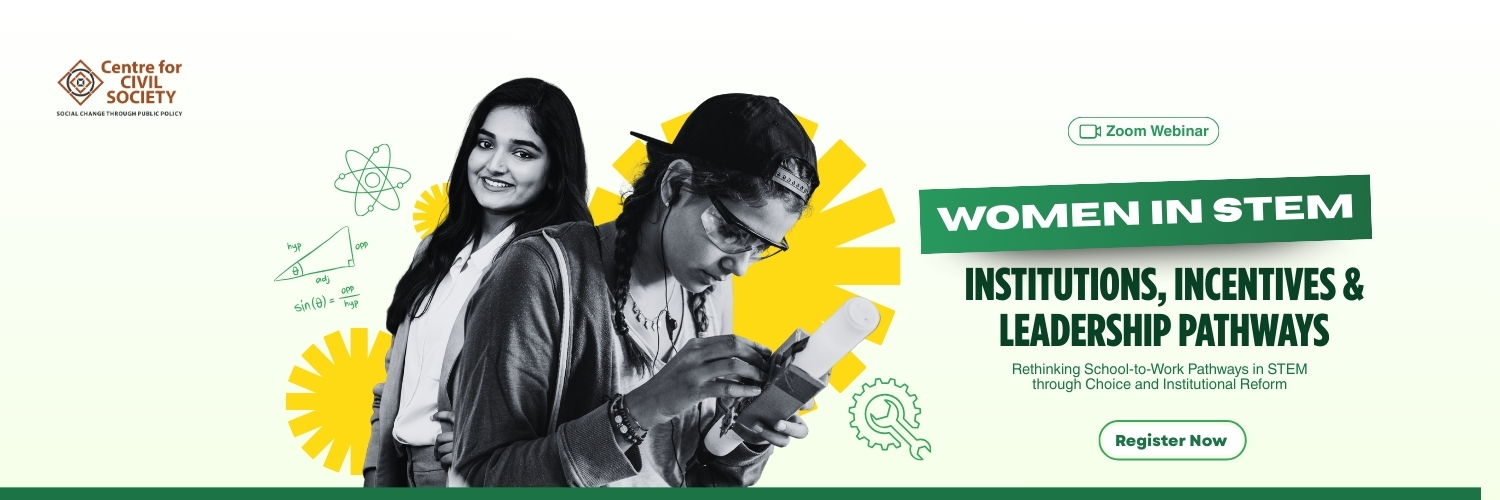
Women in STEM: Institutions, Incentives & Leadership Pathways
Rethinking School-to-Work Pathways in STEM through Choice and Institutional Reform
Join the Discussion for International Women's Day 2026
About the Webinar
Despite significant progress in education, a persistent gap remains for women in Science, Technology, Engineering, and Mathematics (STEM) careers. In India, women constitute 43% of STEM graduates but only 14% of scientists, engineers, and technologists in research development institutions and universities.
The transition from education to leadership is fraught with institutional leaks. This webinar shifts the focus from individual resilience to systemic design. We will dissect how educational pathways, workplace incentives, promotion norms, and policy frameworks shape and often limit women’s long-term participation and leadership in STEM.
Convened ahead of International Women’s Day, this session aims to move beyond awareness to actionable insights for institutional and policy reform.
Key Themes
A. School-to-Work Transitions
Women's participation in STEM often weakens not at entry, but at moments of transition: from secondary to tertiary education, from study to employment, from early career to mid-career consolidation, and from technical roles to leadership positions. These transition points are shaped by institutional design choices such as credentialing requirements, hiring norms, assessment practices, and expectations around career continuity. When transitions are poorly supported or overly rigid, they impose hidden costs on individuals and disproportionately affect women.
B. Institutions & Incentives
Institutions shape behaviour by structuring incentives, signalling expectations, and defining acceptable career trajectories. In STEM fields, education systems, labour markets, and workplaces reward certain patterns of participation while penalising others, often unintentionally. Promotion timelines, evaluation metrics, compensation structures, and workplace norms can favour uninterrupted, linear careers and undervalue alternative pathways.
C. Choice vs Constraints
Discussions on women in STEM frequently invoke "choice" as an explanation for divergent outcomes. Yet choices are always made within institutional constraints that expand or limit available options. When the costs of remaining in STEM are high or the pathways to progression are narrow, individual decisions to exit may reflect constrained choice rather than preference.
D. Leadership Pathways
Leadership in STEM is not simply the result of individual merit or ambition, but of structured pathways that identify, develop, and promote talent. These pathways are often informal, opaque, or poorly aligned with diverse career trajectories. Barriers to leadership can arise from limited access to networks, inflexible promotion criteria, undervaluation of experience gained outside traditional tracks, and the absence of re‑entry mechanisms.
E. Policy & Reform
Improving women's participation and leadership in STEM requires moving beyond isolated interventions towards systemic reform. Policy has a role in shaping education systems, labour market regulations, and workplace norms in ways that enable continuity and progression. Effective reform focuses on institutional design, flexibility, incentive alignment, and long-term impact rather than short-term targets.
Who Should Attend?
- Students & Early-Career Professionals navigating STEM pathways
- Educators, Academic Administrators & Researchers
- Policy Professionals & Development Sector Practitioners
- Employers, Industry Leaders & HR Professionals in STEM fields
- Individuals interested in gender, education, labour markets, and institutional reform
Expected Outcomes
Participants will:
- Develop a nuanced understanding of women’s participation in STEM beyond enrolment and representation
- Gain insights into how institutional design and incentive structures shape career trajectories and leadership outcomes
- Engage with policy‑oriented frameworks centred on choice, continuity, and reform
- Contribute to identifying priority institutional reforms and policy questions for future research, advocacy, and implementation
Tentative Agenda
- 00:00 – 00:10 – Welcome & Opening Presentation: Women in STEM and the Institutional Lens (CCS Team)
- 00:10 – 00:30 – Keynote Address
- 00:30 – 01:20 – Panel Discussion: The Architecture of STEM Careers: Institutions, Incentives, and Outcomes (3 speakers + moderator | includes Audience Q&A)
- 01:20 – 01:30 – Summary, Reflections & Vote of Thanks
(Final speaker details will be shared with registered participants closer to the date.)
For inquiries, contact: snehal@ccs.in


Duration: 90 Minutes
Format: Live Interactive Webinar (Zoom)
Host: Centre for Civil Society (CCS)
Upon registration, you will receive a confirmation email. The Zoom webinar link and instructions will be sent 24 hours before the event.