Policy Research Program by Centre for Civil Society
Are you an undergraduate or recent graduate passionate about public policy, governance, or economic law reform? Apply now for the 25th edition of CCS’s flagship policy research training – Researching Reality 2026!
What is Researching Reality?
Researching Reality is the Centre for Civil Society’s annual flagship public policy research training program, offering eight weeks of immersive learning, research, and mentorship. Regarded as one of India’s premier policy research residency programs, it is designed for undergraduate students and fresh graduates who are keen to build careers in law, economics, policy analysis, governance, or social impact sectors.
Over the last 25 years, this program has equipped aspiring researchers with critical tools to understand, evaluate, and influence India’s policy landscape. Going strong, we’re back with the 26th edition of Researching Reality.
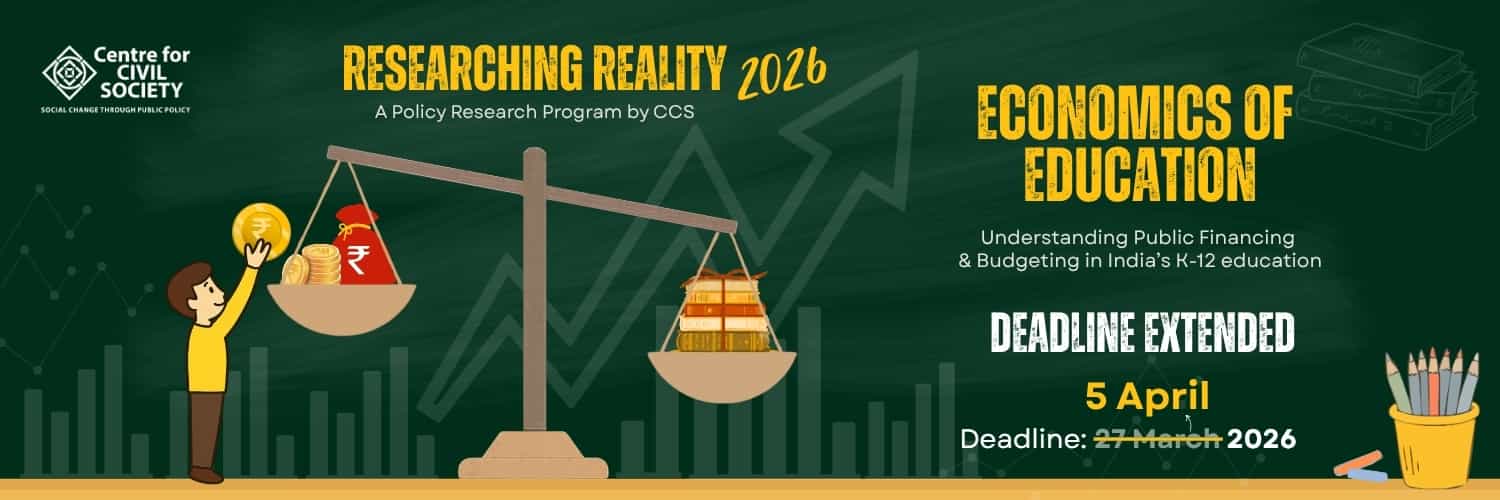
Theme for 2026: Economics of Education – Understanding how public financing and budgeting shape India’s K–12 schools.
India’s vision of a Viksit Bharat depends on strengthening its education system through effective implementation of the National Education Policy (2020). While allocations for school education have steadily increased, overall public spending remains around 4% of GDP, below the 6% target set by NEP. More critically, higher expenditure has not consistently translated into improved learning outcomes, with foundational literacy and numeracy levels still lagging. These gaps make it essential to examine not just how much is spent on education, but how effectively those funds are allocated, structured, and utilised.
Against this backdrop, Researching Reality 2026 will focus on budget expenditure on K–12 school education in India. The program aims to demystify government budgets and encourage rigorous, critical analysis of key financial statements and policy documents related to the education sector, focussing on school education.
Program Dates & Location
Duration: 1 June – 31 July 2026
Location: Centre for Civil Society, Hauz Khas, New Delhi
Commitment: In-person | Full-time | 40 hours/week
Who Should Apply
- Pursuing or recently completed a degree in economics, public policy, or other related social sciences
- Demonstrated interest in public policy, with strong research aptitude and comfort in quantitative analysis.
- Strong analytical, writing, and communication skills in English and Hindi
Why Join Researching Reality?
Rigorous Research Training
40+ hours of expert-led sessions in qualitative and quantitative research, policy analysis, data visualization, and fieldwork design.
Mentorship & Guidance
Work closely with experienced researchers and policy practitioners throughout your residency.
Policy Publication
Contribute to a published research compendium and co-author a policy research essay on India’s regulatory reforms.
Enriching Community
Engage in weekly reading groups, policy roundtables, and knowledge-sharing sessions with CCS’s wider research community.
Program Stipend
Monthly stipend of ₹10,000 per month for the duration of the program.
Applications are now closed.
About Centre for Civil Society (CCS)
The Centre for Civil Society (CCS) is India’s leading liberal think tank, working to advance social change through public policy. CCS conducts research, pilot projects, and advocacy across key areas such as education, livelihoods, governance, and ease of doing business. By engaging with policymakers, academia, media, and grassroots communities, CCS strives to bring greater freedom and choice to individuals, while promoting accountability and transparency in governance.
-
What facilities will be available to me?
You will receive access to our extensive library and network of scholars.
-
Does CCS provide accommodation for outstation applicants?
The scholars are requested to make their own living arrangements in New Delhi for the training period.
-
Will I be working in a group or individually?
All scholars will work in groups of 3-4 members. Peer learning is a crucial part of the training program.
-
Is CCS flexible with the timeline of the program?
While April and May are self paced and flexible, June and July are full-time in Delhi. We are unable to offer flexibility during those two months. August would focus on wrapping up the capstone project; it would be remote and part-time.
-
Will researchers get paid for the Researching Reality 2026 Programme?
Yes, Researchers will receive a monthly stipend of ₹10,000 for the duration of the Researching Reality 2026 Programme.